
incomplete draft
Second-order Compassion
I recently wrote the following tweet in response to Andrés Gómez Emilsson’s request for examples of overlooked ethical emergencies.
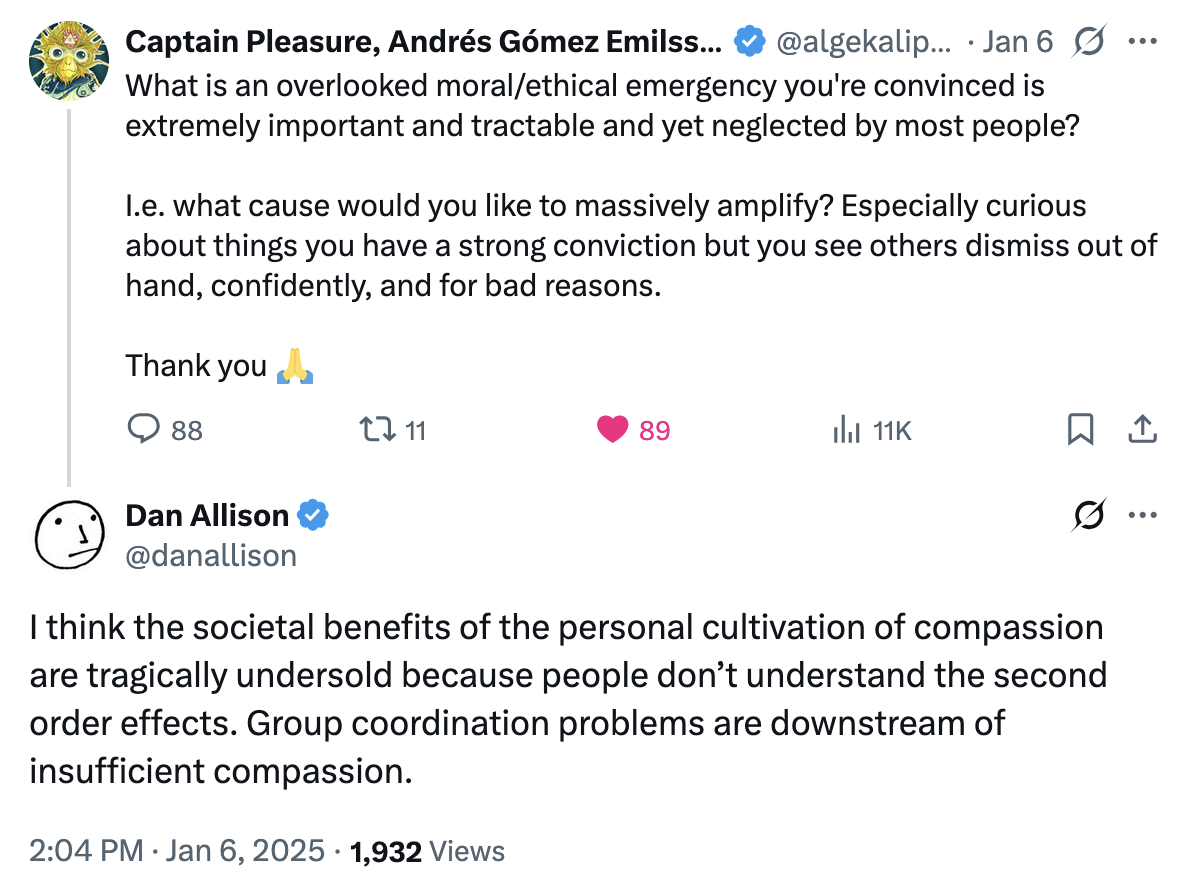
I’d like to expand on this idea a little bit and explain what I mean.
Personal Cultivation of Compassion
For those who engage in compassion practices like mettā meditation, it can be easy to forget that for many people the idea that compassion is a skill that you can get better at through practice is a fairly novel concept. People often think of compassion as simply a quality or feeling that you have or don’t have, not a skill that you practice.
Second-order Effects
The term “second-order effects” basically means the same thing as domino effects or ripple effects. Causes lead to first-order effects, which then become the causes of second-order effects, which then cause third-order effects, fourth-order, and so on.
Compassion Bootstraps Alignment
Something something iterated prisoner’s dilemma.
Skillful compassion initiates a chain reaction.
???
Self-compassion is not selfish
When you account for the second-order effects of self-compassion, it becomes clear that there is nothing selfish about it. The expression “put your own oxygen mask on first” is often used to justify self-compassion and self-care. But even that perspective undersells the collective benefits of self-compassion.
It’s not just that self-compassion enables someone to then be compassionate towards others. It’s that self-compassion itself causes ripple effects that benefit others.
???